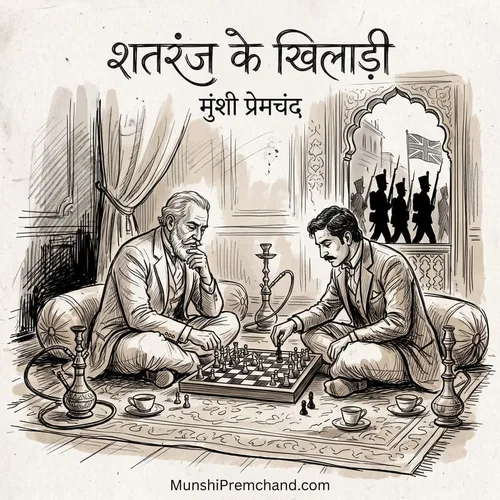
It was the reign of Wajid Ali Shah. Lucknow was completely submerged in luxury and pleasure. High and low, rich and poor—all were drowned in sensory delights. One hosted assemblies of music and dance; another found bliss in the stupor of opium.
Aesthetic pleasure dominated every sphere of life. In administration, literature, social life, arts, crafts, commerce, and daily habits—hedonism reigned everywhere. Government officials were immersed in sensual indulgence, poets in verses of love and longing, craftsmen in embroidery and lace, and merchants in trading perfumed oils, kohl, and cosmetics.
The intoxication of luxury clouded everyone's eyes. No one knew or cared what was happening in the rest of the world. Quail fights were held; betting matches were arranged for partridges; elsewhere, dice games rattled; somewhere else, a fierce battle raged on the chessboard. From the king down to the street pauper, everyone was obsessed with these pastimes. So much so that if beggars received a few copper coins, they would buy opium or liquor instead of bread.
Arguments were boldly advanced that playing chess and cards sharpened the intellect, developed strategic foresight, and cultivated the habit of solving complex problems—a school of thought that is by no means extinct today! Therefore, if Mirza Sajjad Ali and Mir Roshan Ali spent the greater part of their days sharpening their intellects, what reasonable man could object?
Both possessed inherited ancestral estates (jagirs); they had no economic anxieties. Sitting at home, they indulged their whims. What else was there for them to do?
Every morning, after breakfast, the two friends would spread out the chessboard, arrange the carved wooden pieces, and launch into tactical battles. Then they lost all count of time—noon came and went, afternoon faded, evening descended! Repeated summons came from inside the house that dinner was served. From the game room, the answer went back: "Yes, coming! Lay out the cloth!" Eventually, the frustrated cook would bring the food right into the room, and the two friends would eat and play simultaneously.
Since there were no elders in Mirza Sajjad Ali's house, the games were held in his outer reception room (diwankhana). But this did not mean his household was pleased with his habits. Not just the family members, but the neighbors and household servants constantly traded bitter remarks: "What a cursed game! It destroys homes! May God protect anyone from catching this addiction—it leaves a man fit neither for this world nor the next. It's a dreadful disease!"
Mirza's wife (Begum Sahaba) held such deep hatred for the game that she seized every opportunity to reprimand her husband. But she rarely found the chance. By the time she woke up in the morning, the chessboard was already laid out; and when she went to sleep at night, Mirza was still playing. However, she took out her frustration on the servants: "What? He wants betel leaves? Tell him to come get them himself! No time to eat? Go dump the food on his head—let him eat it or feed it to the dogs!"
Yet face to face, even she could say little. Her resentment was directed less at her husband and more at Mir Sahib. She had nicknamed him "Mir the Destroyer." Perhaps Mirza, to clear his own name, laid all the blame on Mir Sahib's shoulders.
One day, the Begum Sahaba developed a severe headache. She said to her maid, "Go call Mirza Sahib. Tell him to fetch medicine from the physician. Run quickly!"
When the maid arrived, Mirza said, "Go on, I'm coming shortly."
The Begum had a quick temper. She could not endure that she should have a headache while her husband sat playing chess. Her face flushed red. She told the maid, "Go tell him to come this instant, or I'll walk to the physician's house myself!"
Mirza was engaged in a most thrilling game; he was just two moves away from checkmating Mir Sahib. He snapped in annoyance: "Is she on her deathbed? Can't she wait a moment?"
Mir Sahib advised, "Well, go and listen to her first. Women are delicate by nature."
Mirza replied, "Oh yes, why shouldn't I leave? You're getting checkmated in two moves!"
Mir Sahib laughed, "Don't count on it, my friend! I've thought of a move that will leave your pieces stranded and checkmate you instead. But go, hear what she has to say. Why hurt her feelings unnecessarily?"
Mirza insisted, "I'll deliver the checkmate first, then go!"
Mir Sahib declared, "I won't play until you go and see her."
Mirza grumbled, "Confound it, I'll have to go to the physician's. Her headache is a total sham—just an excuse to bother me!"
"Whatever it is, you must show her consideration," Mir Sahib urged.
"Alright, let me make just one move."
"Absolutely not! I won't touch a piece until you return."
Reluctantly, Mirza went inside. The Begum glared at him with furrowed brows, moaning with fake agony: "You love that wretched chess so much! Even if someone dies, you won't rise from your seat! May no woman ever get a husband like you!"
Mirza made excuses: "What could I do? Mir Sahib wouldn't let me leave. I managed to escape with great difficulty."
The Begum snapped: "Just because he is an idle loafer, does he think everyone else is the same? Doesn't he have a family, or has he wiped them all out?"
Mirza defended: "He's a very persistent man. Whenever he comes over, I'm forced to play."
"Why don't you turn him away?"
"He's a man of equal social standing—two inches higher in age and rank. One must observe manners."
"Then I'll turn him away myself! Let him get offended—who cares? Is he feeding us? Raniya, go outside and bring in the chessboard. Tell Mir Sahib that Master won't play anymore; he may take his leave!"
Mirza panicked: "No, no! Don't commit such a disaster! Do you want to humiliate me publicly? Stop, Raniya, where are you going?"
The Begum flared up: "Why shouldn't she go? May my blood be on your hands if you stop her! Fine, you stopped her—now try stopping me!"
Saying this, the enraged Begum stormed toward the reception room. Poor Mirza turned pale. He began pleading: "For God's sake, in the name of Hazrat Hussain, I beg you!"
The Begum paid no heed. She reached the door of the reception room, but suddenly her feet halted—going before a strange man went against her modesty. She peeped inside; by good fortune, the room was empty. Mir Sahib had shifted a couple of pieces on the board and was pacing outside on the veranda to show his innocence.
Seeing her chance, the Begum stepped inside, overturned the chessboard, threw some pieces under the divan and others out into the courtyard, and slammed the door shut from the inside!
Mir Sahib was standing right outside. He saw the wooden pieces flying out and heard the jingle of bangles. Then the door slammed shut. He understood instantly: the Begum Sahaba had blown her top. Quietly, he took the path to his own house.
Mirza came out and gasped, "You've ruined everything!"
The Begum retorted: "If Mir Sahib comes here again, I'll have him thrown out on his ear! If you devoted half this devotion to God, you'd become a saint! You sit playing chess while I slave away worrying about the kitchen! Are you going to the physician's now, or are you still hesitating?"
Mirza left the house, but instead of going to the physician, he went straight to Mir Sahib's house and narrated the entire incident.
Mir Sahib said, "When I saw the chess pieces flying out, I guessed it immediately and took to my heels! She seems to have quite a temper. But you've spoiled her too much, Mirza—that's not right. What business is it of hers what you do outside? Managing the house is her duty; what concern does she have with other matters?"
Mirza sighed, "Well, leave that aside—tell me, where do we gather now?"
Mir Sahib replied, "What's there to worry about? My large house is lying right here! We'll set up camp right here."
Mirza hesitated, "But how will I pacify my Begum? When I sat at home, she threw such fits; if I sit here all day, she might not leave me alive!"
Mir Sahib scoffed, "Let her bluster! She'll calm down in a few days. Just do one thing—stand firm from today!"
For some undisclosed reason, Mir Sahib's wife preferred that her husband stay away from home as much as possible. Therefore, she never criticized his love for chess; in fact, if Mir Sahib was delayed, she would gently remind him. This led Mir Sahib to harbor the illusion that his wife was exceptionally obedient and understanding!
However, when the chessboard began to be laid out in his own reception room every single day, and Mir Sahib remained in the house all day long, the Begum Sahaba began to suffer greatly. Her freedom was curbed; she longed even to peek out the front door.
The household servants also began muttering among themselves. Previously, they had lounged around all day swatting flies; whoever came or went was none of their concern. Now they were under twenty-four-hour tyranny! Orders for betel leaves came one moment, sweets the next, and the hookah burned continuously like the heart of a passionate lover.
They went to the Begum Sahaba and complained: "Huzoor, Master's chess has become a torment for our lives! Our feet have broken out in blisters running errands all day. What kind of game is this that starts at dawn and lasts till dusk? A game for an hour or half for amusement is fine, but this is a curse! The man who plays this game never prospers; some calamity is bound to strike the house! People say whole neighborhoods have been ruined by it. The entire street is talking about it. We eat Master's salt, so hearing our master bad-mouthed hurts our hearts—but what can we do?"
The Begum Sahaba replied, "I don't like it myself, but he listens to no one—what can be done?"
Even the few elders in the neighborhood began whispering ominous warnings: "Things won't end well. When our noble lords behave like this, God help the country! This kingdom will be destroyed at the hands of chess. The signs are dire!"
Anarchy reigned across the kingdom of Awadh. Citizens were robbed in broad daylight, and there was no one to hear their grievances. The wealth of the countryside was sucked into Lucknow, where it was squandered on courtesans, dancing girls, female impersonators, and lavish hedonism.
The debt owed to the British East India Company mounted higher every day. The blanket was getting soaked and heavy. Due to administrative chaos, annual land revenues went uncollected. The British Resident issued warning after warning, but the ruling class was drowned in sensory stupor; not a single warning registered on their ears.
Several months passed with chess being played in Mir Sahib's reception room. New tactical combinations were solved, new fortresses built, new battle formations tested. Occasionally, heated arguments erupted, leading to personal insults; but soon the two friends reconciled. Sometimes a game was abandoned in huff, Mirza would march home in anger, and Mir Sahib would retreat to his room. But a night's sleep washed away all bitterness. By next morning, both friends would arrive in the reception room.
One day, while both friends were deep in the quagmire of chess, an officer of the Royal Army arrived on horseback, asking for Mir Sahib.
Mir Sahib lost his wits! What calamity was this? Why had a royal summons arrived? Things looked dangerous!
He locked the front door and told his servant, "Tell him Master is not at home."
The officer asked, "If he's not at home, where is he?"
The servant replied, "I don't know. What is the business?"
The officer sneered, "Why should I tell you the business? He has been summoned by His Majesty. Soldiers are being drafted for the army. Does he think holding a jagir is a joke? When he has to march to the battlefront, he'll learn the price of flour and lentils!"
The servant said, "Very well, I will inform him."
The officer declared, "Inform him? I will return tomorrow myself—I have orders to bring him along!"
The officer rode away. Mir Sahib's soul trembled with terror. He said to Mirza, "Tell me, my friend, what will happen now?"
Mirza gasped, "It's a huge disaster! What if a summons comes for me too?"
"The wretch said he'll return tomorrow!"
"It's a nightmare! If we have to march to the front line, we'll die an unheroic death!"
Mir Sahib said, "There's only one trick—don't be found at home! From tomorrow, we'll lay out our board somewhere far across the Gomti River in the wilderness. Who will know where we are? The officer will come, find no one, and return."
Mirza marveled, "By Allah, what a brilliant idea! There's no other way out!"
Meanwhile, Mir Sahib's Begum was praising the officer: "You played your part wonderfully!"
The officer chuckled, "I can make such fools dance on my fingertips! All their intelligence and courage have been devoured by chess. Now they won't dare stay at home even by mistake!"
From the very next morning, the two friends slipped out of their houses before dawn. Carrying a small mat under their arms and a box of betel leaves in hand, they crossed the Gomti River to a ruined, deserted mosque built during the reign of Nawab Asaf-ud-Daula. On the way, they bought tobacco, clay pipe bowls, and matches.
Upon reaching the abandoned mosque, they spread their mat, lit the hookah, and sat down to play chess. Now they held no worry for the world or the faith. Except for technical terms like "Check!" and "Queen!", hardly a word escaped their lips. No meditating yogi in deep trance could match their intense concentration!
At noon, when hunger struck, they walked to a nearby baker's shop, ate a quick meal, smoked a pipe, and returned to the field of battle. Sometimes they even forgot to eat.
Meanwhile, the political condition of the country was turning grave. The armies of the British East India Company were marching toward Lucknow. Panic gripped the city; people were packing their belongings and fleeing to the countryside.
But our two chess players held not the slightest concern. When they walked to and from the mosque, they used narrow back alleys, fearing that a royal press-gang might spot them and drag them into military service. They wanted to digest their thousands of rupees in annual ancestral revenue for free!
One afternoon, both friends were absorbed in their game amid the ruins of the mosque. Mirza's position was weak; Mir Sahib was delivering check after check.
Suddenly, the marching sound of Company troops echoed in the distance. It was a British regiment arriving to take control of Lucknow!
Mir Sahib remarked, "The British army is coming. May God protect us!"
Mirza replied, "Let them come! Save your King—here is a check!"
Mir Sahib urged, "Let's stand behind the wall and take a look!"
Mirza snapped, "You can look later—what's the hurry? Here's another check!"
Mir Sahib looked through a gap in the wall: "They have artillery too! Must be at least five thousand men. What powerful soldiers—red faces like monkeys! Just looking at them strikes terror!"
Mirza scoffed, "My dear sir, don't make excuses! Try these tricks on someone else—here is your check!"
Mir Sahib protested, "You're a strange man! Disaster has struck the city, and you're obsessed with checks! Do you have any idea—if the city is surrounded, how will we get home?"
Mirza replied coldly, "When it's time to go home, we'll see! Check! This check is checkmate!"
The British army passed by. It was ten in the morning. The game resumed.
Mirza asked, "What about lunch today?"
Mir Sahib replied, "Well, I'm fasting today. Are you feeling very hungry?"
"No, not really. But who knows what is happening in the city!"
"Nothing will be happening. People will be eating and resting peacefully. His Majesty the Nawab must be in his pleasure palace."
They played on until three in the afternoon. This time Mirza's position was weak. As the clock struck four, the sound of returning troops echoed.
Nawab Wajid Ali Shah had been arrested! The British army was taking him away to an unknown destination.
There was no chaos in the city, no bloody battle, no resistance. Not a single drop of blood was shed. Never in history had the king of an independent nation been overthrown so quietly, without the spilling of blood!
This was not the non-violence that pleases the gods; it was the cowardly apathy over which even cowardice weeps! The ruler of the vast kingdom of Awadh was being led away a prisoner, while Lucknow slept the sleep of pleasure. It was the ultimate nadir of political decadence.
Mirza remarked, "The oppressors have arrested His Majesty the Nawab."
Mir Sahib replied indifferently, "So be it. Here is your check!"
Mirza paused, "Wait a moment, my friend. My heart isn't in the game right now. Poor Nawab Sahib must be weeping tears of blood!"
Mir Sahib sneered, "Let him weep! Where will he find such luxuries in captivity? Here's your check!"
Mirza sighed, "No one's fortune stays the same forever. What a heartbreaking tragedy!"
Mir Sahib insisted, "Yes, yes, indeed—now here's another check! You can't escape this one!"
Mirza exclaimed, "By God, you are utterly heartless! Such a massive tragedy has occurred, and you feel no grief? Ah, poor Wajid Ali Shah!"
Mir Sahib snapped, "First save your own King, then mourn for the Nawab! Here's your check and mate! Hand over the stakes!"
The British army escorting the captive King passed right in front of the mosque. The moment they were gone, Mirza laid out the pieces again. The sting of defeat is bitter.
Mir Sahib mocked, "Come, let us compose an elegy in memory of the Nawab!"
But Mirza's sudden patriotism had vanished along with his defeat; he was desperate to avenge his loss.
Evening descended. Bats began to screech in the ruins; swallows returned to their nests in the arches. But the two players remained locked in battle, like two bloodthirsty warriors fighting to the death.
Mirza had lost three consecutive games; the fourth game was going badly too. Repeatedly he tried to play with extreme caution, but one wrong move ruined everything. With every defeat, his urge for revenge grew fiercer.
On the other side, Mir Sahib was singing romantic verses in delight, snapping his fingers as if he had unearthed a hidden treasure. Mirza boiled with frustration, offering fake compliments just to hide his embarrassment. But as his position weakened, his patience wore out completely. He began picking quarrels over every move:
"Sir, don't change your move! What is this—you make a move and then take it back? Whatever you want to play, play it once! Why are you keeping your hand on the piece? Leave the piece! Don't touch a piece until you've decided your move! You take half an hour for a single move—that's illegal! Anyone taking more than five minutes per move should be declared defeated! Look, you changed your move again! Quietly place the piece back where it was!"
Mir Sahib's Queen was about to be captured. He argued, "When did I ever make that move?"
Mirza insisted, "You already made the move! Put the piece back in that square!"
"Why should I put it back? Did I ever take my fingers off the piece?"
Mirza snapped, "If you don't release the piece till Doomsday, does it mean you haven't moved? Seeing your Queen captured, you've started cheating!"
Mir Sahib retorted, "You are the one cheating! Victory and defeat are decided by fate—no one wins by cheating!"
"So you admit your defeat in this game?"
"Why should I admit defeat?"
"Then put the piece back in the square where it was!"
"I won't!"
"You must!"
The argument escalated fiercely. Neither man would yield an inch. Personal insults began to fly.
Mirza sneered, "If anyone in your family had ever played chess, you'd know its rules! Your ancestors were busy cutting grass—what would you know about chess? Nobility is a different matter altogether! Getting a jagir doesn't make a man a gentleman!"
Mir Sahib flared up, "What? My ancestors cut grass? Yours must have cut grass! My family has been playing chess for generations!"
Mirza mocked, "Oh, go on! Your father spent his life working as a cook in Ghazi-ud-Din Haider's kitchen, and today you pretend to be a noble! Being a gentleman is no joke!"
Mir Sahib screamed, "Why blacken the faces of your own elders? Your ancestors were the cooks! Ours always ate at the King's royal table!"
Mirza shouted, "Shut up, you fool! Don't talk so big!"
Mir Sahib drew himself up: "Mind your tongue, or it will end badly! I am not accustomed to hearing such insults. If anyone dares glare at me, I pluck out his eyes! Do you have the courage?"
Mirza sneered, "You want to see my courage? Then come on! Let's settle this with steel today, right here!"
Mir Sahib yelled, "Do you think I'm afraid of you?"
Both friends drew the sharp swords from their waists.
It was the era of Awadh nobility; everyone carried swords, daggers, and rapiers. Both men were hedonists, but they were no cowards. Their political virtue had rotted away—why die for the King or the kingdom?—but personal physical bravery was not lacking.
They lunged at each other with naked swords. Both suffered fatal wounds, fell to the earth, and died thrashing in their own blood.
The very men for whose captive King not a single tear had fallen from their eyes, gave up their lives defending a wooden Queen on a chessboard!
Darkness settled over the ruins. The chessboard lay untouched between them.
The two wooden Kings sat on their respective thrones, as though weeping over the foolish death of these two warriors.
An absolute silence enveloped the sanctuary. The broken arches of the ruined mosque, the fallen walls, and the dust-covered minarets looked down upon the corpses and beat their heads in silent grief.
Significance & Themes
- Political Apathy & Feudal Decadence: Premchand delivers a scathing critique of a ruling class that retreats into private hedonism, rendering an entire society helpless against colonial annexation.
- The Illusion of Bravery: The story highlights the tragic irony of men who lack the civic courage to defend their nation, yet willingly kill each other over an artificial game of honor.
- Contrast Between Real and Imaginary Warfare: While real armies capture Awadh without shedding a drop of blood, the two aristocrats treat their wooden chess pieces as a matter of life and death, symbolizing the complete displacement of public duty by private obsession.