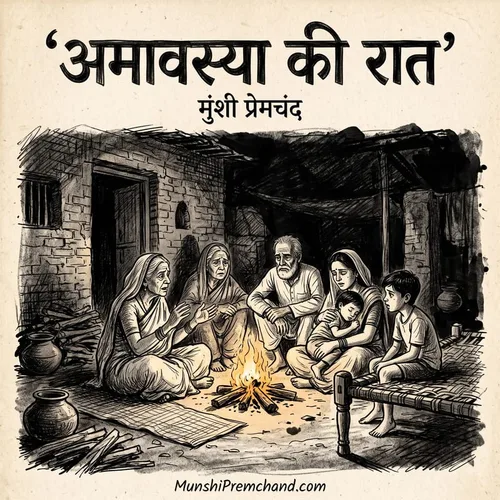
Complete English Translation: Amavasya Ki Raat (The Moonless Night)
1
It was the evening of Diwali. Even the rubbish heaps and ruined hovels of Shrinagar had their fortunes brightened today. Boys and girls of the township were walking toward the temple carrying brass platters adorned with glowing earthen lamps, their faces radiant in the flickering golden light. Every homestead was dazzling with illumination.
Only Pandit Devdatt's ancestral mansion—the once magnificent Satdhara Bhavan—stood in the gloomy shadow of a dark cloud, towering grim and terrible.
Grim, because it could never forget the days of its former grandeur; terrible, because this festive sea of glittering lights seemed to mock its desolate ruin. There was a time when even jealousy rubbed its hands in envy beholding this palace; and now there was this hour, when even contempt cast scornful glances upon its decay.
At the great portal, in place of regal sentries and doorkeepers, stood wild madar and castor bushes. In the grand reception hall (diwankhana), an arrogant stray bull strutted about in undisturbed mastery. In the upper chambers, where once lovely maidens sang enchanting melodies, only the plaintive cooing of wild pigeons could now be heard.
Like the moral discipline of a wayward student in an English academy, the palace's very foundations had been shaken; and its weathered walls were cracking apart like the bleeding heart of a widowed woman.
Yet we cannot cast the blame upon Time. To reproach Time is a futile error—this ruin was the natural harvest of foolishness and shortsightedness.
It was the moonless night of Amavasya. Defeated everywhere by the triumph of lamps, darkness seemed to have sought its final sanctuary within this sprawling mansion.
Pandit Devdatt sat immersed in silent, suffocating sorrow in his semi-dark chamber. For an entire month, ruthless Death had made a plaything of the life of his beloved wife, Girija.
The Pandit had always been prepared to endure destitution and misfortune; trust in destiny gave him patience against poverty. But this new affliction was beyond the limits of human endurance. Day after day, the poor man would sit beside Girija's pillow, gazing upon her withered, wasted face, weeping in helpless agony. Whenever Girija wept in despair of her life, he would comfort her tenderly: "Girija, do not weep. You will be well very soon."
Pandit Devdatt's ancestors had conducted a vast banking business. They dealt in immense loans, transactions that involved great revenue collectors, provincial governors (chakledars), and princely states. In those honorable times, integrity was not bought and sold so cheaply. Pledges worth hundreds of thousands were settled upon plain, unsealed letters.
Then came the Great Uprising of 1857. The upheaval swept away dozens of principalities and states, and with them, the wealthy, grain-and-gold-laden Tiwari household was reduced to dust.
The ancestral treasuries were plundered; their great ledgers and account books were sold off as scrap paper to local grocers. When peace returned and the principalities revived, the world had changed completely. Pledges had become subordinate to written stamps, and even within writing, distinctions arose between plain paper and colored judicial contracts.
By the time Devdatt attained maturity, nothing remained of the ancestral estate except this crumbling ruin. There was no means of livelihood left to him. Agriculture required backbreaking physical labor and hardship. Commerce required capital and worldly cunning. Devdatt possessed neither the modern schooling to seek government employment, nor could his ancestral pride permit him to accept religious alms.
Thus, two or three times a year, he would travel uninvited like a distant guest to the homes of his ancestors' former patrons, returning with modest gifts and travel allowances to scrape together a bare subsistence.
If any visible emblem of ancestral prestige remained, it was a massive heap of ancient letters and a bundle of promissory notes (hundis), whose ink had faded like his own dimmed fortune. Pandit Devdatt cherished these papers more dearly than his own life.
On the day of Yama Dwitiya, when every household performed Lakshmi Puja with pomp, Pandit Ji would reverently worship these dusty bundles. If not living Goddess Lakshmi, then at least let them be the memorial shrine of Lakshmi! The day of the second moon was the sacred day of homage to his ancestral dignity.
Call it irony or call it utter folly, the venerable Pandit harbored immense pride in those ancient documents. Whenever a dispute broke out in the village, this army of rotting papers worked wonders, and his rivals were forced to acknowledge defeat. If men whose families have not glimpsed a sword for seventy generations can still boast of being Kshatriyas, then Pandit Devdatt could hardly be blamed for boasting over documents that concealed a princely fortune of seventy lakh rupees!
2
It was the same moonless night of Amavasya. But the festivity of lamps had already exhausted its brief existence.
All around, this was a night of auspicious omen for gamblers, for a loss on Diwali night was believed to bring losses for the entire year. The welcome of Goddess Lakshmi was in full swing. Gold coins were being squandered over mere cowrie shells. At the taverns, water was being sold at the price of liquor.
Apart from Pandit Devdatt, there was scarcely a soul in the entire township who was not feverishly scheming to gather up another's wealth.
Since dawn, Girija's condition had become alarming. Malignant fever threw her into delirium with every passing moment. Suddenly, she started, opened her heavy eyelids, and murmured in a faint whisper: "Today is Diwali, isn't it?"
Devdatt was so utterly broken by despair that even seeing Girija regain consciousness brought him no joy. He replied softly: "Yes, today is Diwali."
Girija cast her tear-filled eyes around the dark room and whispered: "Will no lamp be lit in our house?"
Devdatt burst into bitter, uncontrollable sobs.
Girija spoke again in the same dying whisper: "Look... even on the festive day of the year, our house remains plunged in darkness. Lift me up... I too will light lamps in my home."
Her words pierced Devdatt's heart like poisoned arrows. In man's final hour, life flickers out amid unfulfilled desires and lingering longings.
In that township lived a renowned physician named Lala Shankardas. In his grand dispensary, named Pransanjivan Aushadhalaya (The Life-Restoring Pharmacy), a printing press stood in place of actual medicine chests. Medicines were prepared sparingly, but advertisements were printed in floods.
He was fond of declaring that sickness was merely a luxury invented by the rich, and according to the principles of political economy, this luxury ought to be taxed as heavily as possible.
If someone is poor, let him be! If someone dies, let him die! What right does a pauper have to fall sick and demand free medicine? India's ruin, he argued, was largely due to the curse of free medical treatment; it had made the population careless, weak, and devoid of stamina.
For an entire month, Devdatt had visited him daily to obtain medicine; but the physician had never deigned to pay enough attention for the poor man to reveal his desperate plight. Devdatt had tried everything to reach the tender corner of the physician's heart. He would arrive with tears in his eyes; but the physician's heart was solid rock, devoid of any softness.
It was that same terrifying night of Amavasya. Past midnight, the stars in the celestial dome shone with added brilliance, as though smiling with mocking joy over the extinguished lamps of Shrinagar.
In overwhelming restlessness, Devdatt rose from Girija's bedside and walked toward the physician's residence. He knew full well that Lala Ji would never step out without his fees; yet even in utter despair, hope refuses to abandon a dying man. Step by heavy step, Devdatt pressed forward.
3
The physician was at that moment busily engaged in composing an advertisement for his miraculous elixir, Ramban Bindu (The Infallible Drop). Beholding the evocative phrasing and seductive power of that advertisement, one could scarcely determine whether he was a prince of physicians or an ocean of literary eloquence.
Reader, gaze upon the dazzling mirror of his Urdu advertisement:
"Esteemed Citizens! Do you know who I am? Your sallow complexion, your emaciated frame, your breathlessness at the slightest exertion, your deprivation from the pleasures of the world, your perpetual gloom—all these answer this question in the negative!
Listen to who I am! I am that champion who has undertaken the noble mission of banishing human afflictions from the face of the earth! Who has resolved with unshakeable determination to uproot and eradicate those fraudulent, quack physicians who masquerade as healers!
I am that wondrous being beyond description who transforms the despondent into the joyful, the disappointed into the triumphant, the cowardly fugitive into a lionhearted warrior! And this is accomplished through no sorcery, no incantation; these are the humble miracles of my wondrous invention—Amrit Bindu (The Nectar Drop)!
What is Amrit Bindu? Only I know its celestial secret. Maharshi Agastya whispered this sacred formula into the ears of Dhanvantari! The moment you open the V.P.P. parcel, its radiant truth will be revealed to you. It is the Water of Life (Aab-e-Hayat)! It is the quintessence of manhood, the elixir of wisdom, the marmalade of intellect, and the whetstone of genius!
If years of attending poetic symposia have failed to make you a poet; if day-and-night cramming has failed to pass your examinations; if, despite flattering brokers and pampering clients, you still wander like a starving dog around the courthouse compound; if, despite screaming until your throat splits and banging your fists upon tables, your speeches produce no impression—then take refuge in Amrit Bindu!
Its greatest benefit, which will become apparent on the very first day, is that your eyes will be opened wide, and you will never again fall into the deceptive snares of advertising quacks!"
Having completed this masterpiece, the physician was reciting it aloud with deep satisfaction, rightful pride and ambition gleaming in his eyes, when Devdatt called out from outside.
The physician was delighted. For night calls, his fee was double!
Holding a brass lantern, he stepped out to the verandah. Devdatt instantly fell to the floor, wrapping his arms around the doctor's feet, weeping bitterly: "Physician Ji, have mercy upon me this night! Girija is a guest of this world for only a few fleeting moments. Only you can save her now! Whatever is written in my fate must come to pass; yet if you come with me for one brief moment and look upon her, the agony burning in my breast will be stilled. I will find comfort in knowing that I did all that lay in human power. God knows that I am too destitute to offer you compensation today; but as long as I live, I shall sing your praises and remain the humble slave of your commands!"
For a fleeting second, a spark of pity flickered within the physician's chest; but it was merely the glow of a solitary firefly, instantly swallowed up in the vast, devouring darkness of self-interest.
"Double fee at night," the physician said coldly, stepping back. "Without ten rupees in hand, I do not step into the street." He turned on his heel, withdrew inside, and bolted the heavy wooden doors.
4
It was that same dark night of Amavasya. A deep silence had settled over the trees.
The winners of Diwali gambling were waking their sleeping children to distribute festive coins; the losers were begging forgiveness from their angry, scolding wives.
Suddenly, the continuous chiming of brass bells pierced through the night air and the thick darkness. In that breathless stillness, the rhythmic cadence sounded extraordinarily sweet. The chimes drew nearer and nearer, until they came to a halt right before Pandit Devdatt's ruined mansion.
At that moment, Pandit Ji was drowning in the bottomless ocean of despair. In his grief, he was no longer even capable of moistening the parched lips of his beloved Girija with water.
What could he do? How could he bring that merciless physician here? Cruel wretch! I would have remained your slave for life! I would have printed your bombastic posters! I would have pounded your bitter herbs!
Today, the Pandit finally realized that promissory notes worth seventy lakh rupees were not worth a handful of broken cowries!
The vanity of ancestral pride vanished from his eyes forever.
He pulled the sacred velvet bag from the iron-bound chest. Those yellowed documents—the sole surviving remnant of his forefathers' toil, preserved like sacred honor itself—he now began feeding into the flame of the solitary lamp, one by one.
Just as a human body nurtured in comfort and joy is ultimately offered to the funeral pyre, so too those paper puppets were swallowed up by the flaming jaws of the flickering lamp.
Suddenly, a resonant voice called out Pandit Ji's name from the outer courtyard.
Devdatt started. Groping his way through the pitch darkness, he reached the doorway.
He rubbed his eyes in disbelief. Several attendants stood holding blazing torches, while a magnificent tusker elephant was using its trunk to uproot the wild castor bushes that guarded the entrance like sentries!
Upon the elephant's silver howdah sat a handsome young nobleman. He wore a saffron-colored silk turban; upon his forehead was an arched mark of sandalwood paste; his sharp mustaches bristled like lances; and an aura of authority and radiance shone from his visage. His pleated tunic, fine churidar pajamas, a curved sword hanging at his waist, and golden chains around his neck sat upon his graceful frame with magnificent splendor.
The moment the young nobleman saw Pandit Ji, he set his foot upon the stirrup, descended from the elephant, and bowed low in humble reverence.
Abashed by this extraordinary humility, Pandit Ji asked: "From where has your honor arrived?"
The youth replied with utmost courtesy, gentility flowing from every feature: "I am your old servant. My home is in Rajnagar; I am the jagirdar of that estate. Your noble ancestors showered immense benevolence upon my forefathers. Whatever prestige and prosperity I possess today is the fruit of the mercy and kindness of your house. I have heard your revered name from many elders of my family, and for a long time I have yearned to have your darshan. Today that blessed opportunity has arrived, and my life is fulfilled."
Tears welled up in Pandit Devdatt's eyes. Ancestral pride was the tenderest chord in his heart. The wretched humility that had clouded his face vanished for a moment.
Assuming a dignified air, he said: "It is your noble graciousness that prompts such words. Otherwise, an unworthy descendant like me possesses no merit to call himself their progeny."
Meanwhile, the attendants spread a fine Persian carpet in the courtyard. Both men sat down, and conversation began—words whose every syllable caused Pandit Ji's withered face to blossom, just as the gentle morning breeze opens the petals of flowers.
It turned out that Pandit Ji's grandfather had loaned twenty-five thousand rupees to the young Thakur's grandfather. The Thakur was now preparing to travel to Gaya to perform the sacred ancestral shraddha rites for his forefathers; and religious duty demanded that before embarking on that pilgrimage, every copper of ancestral debt must be paid in full.
The Thakur had discovered this old debt recorded in his family's ancient ledgers. With accumulated interest, the twenty-five thousand had now grown to seventy-five thousand rupees. It was to discharge this debt that the Thakur had come this night.
Righteousness (dharma) is indeed that divine force which generates noble impulses within the human conscience; though to translate such impulses into action requires a pure and heroic soul, without which those same impulses turn cruel and sinful.
Finally, the Thakur said: "You must surely possess those original promissory letters?"
Devdatt's heart sank like a stone into water.
Steeling his trembling voice, he stammered: "Perhaps... they may be here. I cannot say with certainty."
The Thakur said casually: "Please search for them. If they are found, we shall take them with us."
Pandit Devdatt rose to his feet, but his limbs turned cold as ice. A dreadful doubt seized him: was fate merely playing a cruel jest? Who knew whether that particular document had already been burned to ashes in the lamp? If the paper was lost, who would hand over seventy-five thousand rupees?
Alas! That the cup of nectar should be dashed from the lips just as it touches them! O God! Let that one paper be spared! We have suffered endless miseries; have mercy upon us now!
Suspended between wild hope and agonizing dread, Devdatt rushed into the dark room. By the flickering, dying light of the lamp, he began turning over the surviving papers with frantic fingers.
Suddenly, his eyes caught the seal! He leaped into the air! Mad with joy, he jumped two or three times like a man possessed!
He threw his arms around the motionless Girija and cried out: "My darling! If God wills, you shall live! You are saved!"
In his wild frenzy of ecstasy, he did not even perceive that Girija was no longer a living woman—she was merely a lifeless corpse.
Devdatt seized the parchment and rushed toward the doorway with such frantic speed as though wings had been attached to his feet. But reaching the threshold, he checked himself. Restraining the surging waves of joy in his breast, he presented the document with dignified composure: "Here it is. The paper has been found. It is pure coincidence; otherwise, papers worth seventy lakh rupees have become food for termites."
In sudden good fortune, doubt often intrudes. When the Thakur stretched out his hand to take the paper, Devdatt felt a fleeting tremor of suspicion: What if he snatches it and tears it to pieces? Though baseless, man is ever a creature of weakness.
The Thakur sensed the unspoken fear. Taking the document with serene indifference, he held it before the torchlight and said: "Now my conscience is satisfied. Here, your money is before you. Grant me your blessing that my ancestors may attain eternal salvation."
Saying this, he untied a leather pouch from his waist, extracted seventy-five currency notes of one thousand rupees each, and handed them into Devdatt's hands.
Pandit Ji's heart was hammering violently against his ribs; his pulse leaped at a furious pace. He glanced cautiously all around into the shadows to ensure no one was watching; then, with trembling hands, he took the notes.
In a vain attempt to display aristocratic detachment, he did not even count them. Casting only a flying glance over the bundle, he gathered the fortune and thrust it deep into his pocket.
5
It was still that moonless night of Amavasya. The heavenly lamps—the stars—had grown pale and dim. Their fading journey announced the imminent arrival of the Sun God. The eastern horizon had donned its turquoise robe, while a soft whitish glow touched the western sky.
Pandit Devdatt bade farewell to the noble Thakur and walked back into his house. At that moment, his heart was bathed in the pure, radiant light of boundless generosity. No petitioner could have left his door empty-handed this morning.
He immediately resolved to organize a grand recitation of the Satyanarayan Katha with princely feasts. Plans for fine silk sarees and gold ornaments for Girija were settled in his mind.
Stepping into the inner courtyard, he bowed his head with full devotion before the sacred Shaligram stone, and then gathered the remaining promissory notes, returning them safely to the velvet bag.
Not that he believed those dead letters would ever spring to life again; rather, freed from all anxieties of livelihood, he could now indulge in ancestral pride without shame. He was intoxicated with hope, dignity, and renewed vigor.
I need no more wealth in this life! God has granted me enough. With this, Girija and I shall pass our days in contentment and peace.
How could he know that Girija's days had already been cut short?
A tender thought fluttered in his heart: the moment Girija hears this miraculous tidings, she will surely sit up in joy! It was merely anxiety and starvation that had brought her to this miserable state. When a human soul has never enjoyed a full meal, when one has never been free from the heart-wrenching shackles of destitution and hopeless endurance, what else could become of her?
Smiling with love, he approached Girija's cot. Gently shaking her shoulder, he whispered: "Girija, open your eyes! Look, God has heard your prayer and showered mercy upon us. How do you feel now?"
Girija did not stir; not a breath escaped her lips.
Devdatt's smile froze. He pulled back the rough sheet and gazed upon her face.
A cold, agonizing groan tore through his chest. He collapsed beside the cot, clutching his head in his hands. Scalding tears, red as drops of blood, gushed from his eyes.
"Alas! Has this wealth arrived at such a terrible price? Is this the price paid by the court of the Almighty for this precious, beloved life? O God, how cruel is Your justice! I have need of Girija—I have no need of these rupees! This bargain is far too costly! Far too costly!"
6
The dark night of Amavasya had drawn to an end, just like Girija's dark, sorrowful life.
Out in the fields, farmers driving their ploughs were singing melodious morning songs. Children, shivering in the early winter chill, were praying to the Sun God to emerge from the mist.
At the village well, spirited young women had gathered—not merely to draw water, but to laugh and gossip. One, lowering her pitcher into the depths, was mimicking her toothless mother-in-law; another, leaning against a stone pillar, was whispering secrets of young love with a smiling friend; while old matrons, cradling infants in their laps, were cursing their daughters-in-law for taking an hour at the well.
Meanwhile, Royal Physician Lala Shankardas was still enjoying his sweet morning slumber.
Coughing children and groaning old men had already begun gathering at the doors of his dispensary. A short distance from the crowd, two or three handsome but pale young men were pacing nervously, waiting to consult the physician in private.
Suddenly, Pandit Devdatt appeared!
Bareheaded, barechested, his eyes blazing red, his countenance wild and terrifying, he came running down the street clutching a thick bundle of papers!
Reaching the dispensary, he began pounding on the wooden door with such furious, thunderous shouts that the physician started awake in terror and called out to his servant to unbolt the door.
The servant, having returned late from a caste panchayat, suffered from the malady of deep, immovable slumber—a disease that had proved resistant even to the doctor's daily barrage of scoldings. Stumbling to his feet, he unlatched the door and wandered off to look for live embers for his hookah.
The physician was just trying to rise from his cot when Devdatt stormed inside and stood towering over him like an avenging fury!
With a savage motion, Devdatt hurled the massive bundle of seventy-five currency notes onto the physician's lap!
"Physician Ji!" Devdatt cried in a voice that shook the walls. "Here are notes of seventy-five thousand rupees! This is your prize! This is your fee! Go this instant and examine Girija! Do whatever your medical art can do so that she opens her eyes just once!
"All this wealth is an offering for a single glance of hers—only a single glance!
"To you, rupees are dearer than human life. Here they are, lying before you! But to me, a single glance from Girija is thousands of times more precious than all your gold!"
The physician stared at the fortune, and then looked up at Devdatt with overwhelming shame and sorrow.
In a choked whisper, he said: "I am filled with profound grief. I am your debtor and your offender for all eternity. But you have taught me a lesson today that I shall never forget. God willing, such a sin shall never occur again from my hands. I am grieved... truly, deeply grieved!"
And for once in his life, those words came from the deepest sanctuary of the physician's soul.
Summary of Amavasya Ki Raat
'Amavasya Ki Raat' (The Moonless Night) is one of Munshi Premchand's most devastating tragedies on the cruel irony of wealth, the heartlessness of commercialized medicine, and the hollow vanity of ancestral prestige.
The story centers on Pandit Devdatt, living in the decaying remains of a once-princely mansion in Shrinagar. His ancestors had been wealthy bankers whose fortune was wiped out during the 1857 Uprising, leaving Devdatt with nothing except an iron chest filled with ancient promissory notes worth seventy lakh rupees, which he worships as relics of lost glory. On the night of Diwali—coinciding with the dark moonless night of Amavasya—while the whole town glows with oil lamps and festivities, Devdatt's mansion lies in utter darkness. His beloved wife Girija is dying of a malignant fever.
Desperate, Devdatt begs the town's famous physician, Lala Shankardas—a mercenary charlatan who treats medicine as an extortion racket and claims that poverty-stricken people have no right to fall ill—to examine Girija. The physician heartlessly turns him away because Devdatt cannot pay the double night fee in advance. Returning home in despair, Devdatt realizes the utter worthlessness of ancestral pride and begins feeding his prized debt documents into the solitary lamp.
At that moment, a noble young Thakur arrives on an elephant. Preparing to perform ancestral shraddha rites at Gaya, the Thakur has come to repay an old ancestral loan of twenty-five thousand rupees, which with interest has grown to seventy-five thousand. Devdatt miraculously finds the promissory note among the unburned papers and receives the small fortune. Overjoyed, he rushes inside to revive Girija with the miraculous news of their deliverance, only to find that she has already died in the dark.
At daybreak, the grief-maddened Devdatt storms into the physician's clinic, flinging the entire seventy-five thousand rupees at his feet, offering the fortune for a single opening of Girija's eyes. The crushing moral rebuke shatters the physician's arrogance, leaving him genuinely repentant for his inhumanity.
Publication History
'Amavasya Ki Raat' was first published in Urdu under the title 'Amavas Ki Raat' in the April 1913 issue of the celebrated literary journal Zamana. It was later included in Premchand's Urdu collection Prem Pachisi (Part 2, 1918). The Hindi version, titled 'Amavasya Ki Ratri', was published in the collection Nav-Nidhi (1917) and later anthologized in Mansarovar (Vol. 6, 1946).
This unabridged English translation was published in 2026 by MunshiPremchand.com as part of the MunshiPremchand.com English Translation Series.
Themes & Critical Significance
- The Fatal Irony of Wealth: The central tragedy hinges on the temporal cruelty of fate: the wealth that could have saved Girija's life arrives minutes after she passes away. Premchand underscores that money has value only when it serves life; stripped of human presence, gold is mere dust.
- The Satire of Commercialized Healthcare: Through the grotesque caricature of Lala Shankardas and his bombastic "Amrit Bindu" advertisements, Premchand delivers a scathing critique of medical professionals who prioritize profit over compassion and view human sickness through the lens of market taxation.
- The Hollow Vanity of Feudal Ancestry: Devdatt's obsession with seventy lakh rupees of uncollectible ancestral debt represents the paralyzing nostalgia of fallen aristocratic families who cling to paper prestige while starving in real life.
- Light and Darkness as Symbolic Motifs: The contrast between Diwali's festive lamps and Devdatt's desolate mansion reflects deep social inequality. The moonless night (Amavasya) symbolizes the darkness of poverty, neglect, and human mortality, culminating in Devdatt's bitter moral dawn.