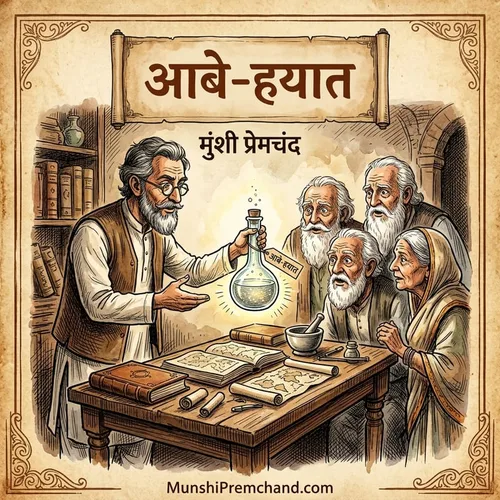
Complete English Translation: Aab-e-Hayat (The Elixir of Life).
Dr. Ghosh was a strange and unusual man. One day, he invited four of his respected friends to meet him in his laboratory. Three of these gentlemen were so advanced in age that their beards had turned completely white. Their names were Babu Dayaram, Thakur Vikram Singh, and Lala Karodimal. The fourth was a widow named Musammat Chanchal Kunwar. Old age had covered her body with wrinkles. All four of these people lived in a state of deep melancholy and sorrow.
Their lives had become bitter, and their greatest misfortune was that they were still alive.
Lala Karodimal had once been a wealthy merchant in his youth. But he had squandered all his fortune in speculation and now survived by means of a respectable sort of begging. Thakur Vikram Singh had been devoted to pleasure and luxury. He had sacrificed not only his wealth but also his health to his appetites, and his body had now become a center of numerous diseases. He was perpetually troubled and dejected. Babu Dayaram had once been a lawyer and had also taken part in nationalist movements. But for one reason or another he had become notorious, and now no one came near him. He spent his days secluded in a corner of failure. As for Musammat Chanchal Kunwar, she had once been famous for her beauty. For a long time she had been known for visiting holy places. The respectable people of the city, and even her close relatives, kept their distance from her. Karodimal, Dayaram, and Vikram Singh had all once been her lovers. Indeed, their rivalry had once gone so far that bloodshed had nearly resulted. But those days were now nothing more than a dream. Even their memory had become painful.
Dr. Ghosh motioned to the men to sit down and said, “Friends! You know that I spend my time conducting one little experiment or another. Today I need your help with an experiment.”
If the stories people told were to be believed, Dr. Ghosh's laboratory was a wondrous place. The room was dark and old-fashioned. Spiderwebs served as curtains over the windows, and years of dust lay thick upon the floor. Several teakwood cupboards stood against the walls, filled with bound books. In the middle cupboard was a statue of Bhairon. Some people believed that whenever Dr. Ghosh found himself in difficulty, he consulted this statue. In the darkest corner of the room stood a tall, narrow cupboard. A human skeleton could be seen faintly inside it. Near it, between two cupboards, was a dim mirror in a tarnished golden frame. It was said that the souls of patients who had died under the doctor's healing hand lived in that mirror, and whenever the doctor looked toward it, all of them would stare back at him. On the other side of the room stood a life-sized portrait of a beautiful woman, though the colors of her face and clothes had faded with the passage of time. Fifty years earlier, Dr. Ghosh had proposed marriage to this woman. But a few days before the wedding she fell ill and died after taking medicine from her devoted doctor.
One of the strangest objects in the laboratory remains to be mentioned. It was a black-bound book whose title no one knew, though everyone knew it as the Book of Magic. Once, the servant had picked it up to dust it. The moment he lifted it, the skeleton standing in the cupboard began to tremble. The woman's portrait moved a step forward, and dozens of terrifying faces began peering out of the mirror. That was not all: the expression of the statue of Bhairon changed, and a voice came from its mouth saying, “Stop, stop.”
Hearing Dr. Ghosh speak of an experiment, his four friends assumed that they would either be shown the death of a mouse in an airless glass tube, or asked to examine a spiderweb through a microscope, or subjected to some other absurd experiment. The doctor had often troubled his friends by asking them to watch such experiments. They therefore felt little enthusiasm for the proposed experiment. But before they could answer, Dr. Ghosh rose and limped toward another corner of the room. He returned carrying the same massive book that was popularly known as the Book of Magic.
He opened the book and took a rose out of its pages. It had once been crimson, but at that moment it had turned brown and dull. Its petals had become so dry that they looked as though they would crumble at the slightest touch.
Taking a deep breath, Dr. Ghosh said, “Fifty-five years ago, this rose, which is now completely withered and crumbling at the slightest touch, was red and blooming. It was a gift from the beautiful woman whose portrait you see hanging there, and I wanted to wear it in my clothes on the day of our wedding. This flower has remained buried in these pages for fifty-five years. Can a flower this old, half a century old, become fresh and green again?”
Musammat Chanchal Kunwar shook her head indifferently and said, “That is like asking whether the wrinkled face of an old woman can become smooth again.”
Dr. Ghosh said, “Very well. Watch.”
He lifted the lid of the vessel standing on the table and placed the withered flower into the water inside. At first the flower simply floated on the surface. The water seemed to have no effect on it. But within a moment, an astonishing change began to appear. The flattened, dry petals moved, and their color slowly began to turn red. It seemed as though the flower were waking from a deep sleep. Its thin stem and leaves became fresh, and before their eyes the fifty-five-year-old flower looked completely fresh and newly opened. It had not yet fully blossomed. Some of the petals at its center remained curled up, and two drops of dew glistened upon them.
Dr. Ghosh's friends said casually, “The spectacle is certainly impressive, but tell us, how did this happen?” They had seen magicians perform tricks far stranger than this.
Dr. Ghosh said, “Have you never heard of Zulumat—the terrible darkness through which Alexander was said to have passed in search of the Pool of Immortality?”
Dayaram said, “Of course I have heard of it. But when has anyone ever found its water?”
Dr. Ghosh replied, “No one found it because no one conducted a proper search. Research has now established that there is a spring of the Elixir of Life in Zulumat. Great trees grow along its banks, and although they are many centuries old, they are still green and flourishing. Taking me to be a devoted student of these discoveries, a friend of mine sent me a little of the water. It is in this cup.”
Thakur Vikram Singh did not believe these things at all. Nevertheless, he asked, “Yes, perhaps. But tell us, can this water have the same effect on the human body?”
Dr. Ghosh replied, “You will know that in a moment. All of you gentlemen, drink this water freely, and let your youth return once more. I have no desire to become young, because I have endured many hardships to reach the stage of life I am in. If you are willing, I shall conduct the experiment on you.”
Saying this, Dr. Ghosh took out four glass tumblers and began filling them with the water. There certainly seemed to be some life-giving power in it, because tiny bubbles continuously rose from the glasses. They came to the surface, formed sparkling sprays, and burst. In addition, a delightful fragrance rose from the water. Seeing this, the men began to have some faith in its properties. They still could not believe that an old man could drink the water and become young, yet all four became ready to drink it.
Seeing them so eager, Dr. Ghosh asked them to pause for a moment and reflect. “My dear and respected friends! You have the experience of an entire lifetime. Therefore, before drinking this water, establish some principles for yourselves, so that the difficulties of youth do not ruin you once again and you may pass safely through this dark valley. Think: after so many experiences of life's changing seasons, if you cannot become examples of good character for the young people of the world, how shameful that would be!”
Hearing this advice, a faint smile appeared on their faces. They made no reply. The very idea seemed laughable—that after such bitter experiences of the errors and recklessness of youth, these people would deliberately fall into them again.
Dr. Ghosh said kindly, “Now drink it with pleasure. I am immensely delighted that I have found such capable men for my experiment.”
With their feeble hands, the four men lifted their glasses to their lips. If, in fact, the water possessed the life-giving power Dr. Ghosh believed it had, there could hardly be anyone in the world who needed it more than these men. Their faces suggested that they had never seen youth at all and had been born old, as though they had always been so worn-out, disappointed, and white-haired. They sat hunched around Dr. Ghosh's table. Even the happiness of approaching youth could not put a glow upon their faces. Their bodies and hearts had become completely lifeless. They drank the water and placed their glasses on the table.
But in an instant, a pleasant change appeared in their condition. Their faces filled out. A glow returned to them. Color appeared in their pale, lifeless cheeks. They looked at one another. It seemed to them that some electric force was erasing from their bodies the marks that the merciless passage of time had been engraving there for decades. Musammat Chanchal Kunwar felt as though youth were returning to her. She modestly drew her veil farther over her face.
Everyone exclaimed happily, “Give us a little more of the Elixir of Life. We have certainly become somewhat young, but there is still something lacking. Come, quickly give us another glass!”
Dr. Ghosh, who was sitting and observing his experiment with scholarly interest, said, “Have a little patience. It took you many years to grow old, but you should not become restless if becoming young takes half an hour. The water is here. You may drink as much as you wish.”
Saying this, Dr. Ghosh filled all four glasses again. There was still enough water in the vessel to make half the old men in the city the same age as their grandchildren. The glasses were still bubbling when the four men snatched them from the table and emptied them in a single gulp. It was certainly the Elixir of Life. No sooner had the water passed down their throats than a transformation began in their appearance. A youthful light appeared in their eyes. Their white hair began to turn black. Another moment passed. In place of four old men, three young men and a beautiful, flower-like young woman were sitting around the table.
Looking at Chanchal Kunwar with a drunken, admiring gaze, Thakur Vikram Singh said, “Dear Chanchal, you look wonderfully radiant at this moment.”
Just as the light of dawn gradually drives away darkness, Chanchal Kunwar's face became more and more radiant. She had enough experience to know that Thakur Sahib's compliments were not always sincere, so she hurried to the mirror and began examining her reflection. She was still afraid that she might see the repulsive face of old age. From the manner of the other three men, it appeared that the water had some intoxicating quality. Perhaps the burden of old age had been lifted from their heads, making them drunk with happiness.
Babu Dayaram was pondering matters of the state, but it was difficult to tell whether those matters concerned the present, the past, or the future. At one moment he would begin speaking loudly about patriotism, service to the nation, or human rights. At another, he would whisper about some confidential matter so quietly that he could scarcely hear his own voice. Sometimes he would speak hesitantly and with extreme politeness, as though addressing a high official.
Thakur Vikram Singh was humming some popular tune and tapping his fingers rhythmically on his glass. His eyes remained fixed on Chanchal Kunwar's beautiful face. On the other side of the table, Lala Karodimal was absorbed in accounts and ledgers, thinking about how much profit could be made if blocks of ice were cut from the Himalayas and brought down for sale. Chanchal Kunwar stood before the mirror, smiling happily as she examined herself. Again and again she brought her face close to the glass to see whether any old blemish remained. Even now she was not completely satisfied with her renewed appearance. She remembered that she had been even more beautiful in her youth. At last she came near the table, lifting her veil slightly, and said, “Doctor Sahib, please give me another glass.”
Dr. Ghosh laughed and said, “Yes, yes, take it gladly. Here, I shall fill the glass for you.”
Glasses filled with the Elixir of Life stood upon the table. The fine sprays rising from them glittered like rays from diamonds. The sun had already set, so the room had grown darker, but a faint moonlike light seemed to rise from the vessel and fall upon the faces of the doctor and his friends. The wrinkles and pallor on the doctor's face appeared even more pronounced in that light.
As soon as they drank the third glass, waves of youthful excitement began surging through the veins of all four. Their youth was now in full bloom. The joy in their hearts could hardly be contained. The old age of disappointment, grief, and helplessness now seemed to them like a dream they had seen long ago. Everything began to appear especially bright to them. The spiritual freshness from which they had been prematurely deprived, and without which the world's enchanting sights had seemed like blurred pictures, now once again cast its spell of desire over them. They felt as though they were new beings in a new world. All of them bent forward and exclaimed, “We have become young! We have become young!”
In truth, they were a company of frivolous young people whom the demands of age had now driven toward madness. The strangest feature of their merriment was that they felt an irresistible urge to mock the old age and weakness from which they had only just been freed. Looking at their old clothes, they burst into laughter. One of them imitated an old man groaning from the pains of changing weather and began walking with a limp. Another put spectacles on his nose and pretended to read the Book of Magic intently. The third sat in an armchair and imitated Dr. Ghosh's solemn dignity. Then all of them began clapping their hands and jumping about the room.
Musammat Chanchal Kunwar approached Dr. Ghosh in a captivating manner. Her rose-like cheeks carried a charming and mischievous playfulness. She said to the doctor, “Dear Doctor, get up and dance with me.”
At this, all four men burst out laughing, thinking that Dr. Ghosh would look extremely foolish beside this beautiful woman.
Dr. Ghosh said solemnly, “Forgive me! I am old, and rheumatism has made life miserable for me. My dancing days have long since passed. But any one of these three young men would gladly give his life to dance with you.”
Thakur Singh said, “Chanchal, dance with me.”
Babu Dayaram said, “No, she will dance with me.”
Lala Karodimal said, “Indeed, I am her old companion. Fifty years ago she promised to dance with me.”
As they spoke, the three men gathered around Chanchal Kunwar. One desperately seized both her hands. Another put his arm around her waist, while the third began kissing her fragrant hair. Chanchal Kunwar alternately blushed, frowned, cursed, laughed, and struggled. Her warm breath passed over the faces of the three men one after another, intoxicating them like a cool breeze. She struggled to escape from their midst, but she could not free herself. Few could have witnessed such a heated rivalry for the companionship of a magical beloved. Yet the life-sized mirror in the room presented a very different spectacle. There, three aged men were struggling to embrace a crooked, repulsive, wrinkled old woman with a bent back.
But they were young. Their intoxication proved it. Enraptured by Chanchal Kunwar's gestures and resistance, the three rivals began casting angry looks at one another. Clinging to the beautiful beloved, they fell upon one another. A scuffle and blows began. In the confusion, someone struck the table and overturned it. The glass vessel fell and shattered, and the life-giving water poured across the floor in a brilliant stream. A half-dead butterfly lay on the ground, gasping. Its wings became wet from the stream, and it suddenly flew up and landed on Dr. Ghosh's hat.
Dr. Ghosh said, “Enough, enough, friends! Enough. Chanchal Kunwar, enough! This has gone too far. I do not like this commotion at all.”
They all fell silent. A shiver passed through them. It seemed to them that the ancient, decrepit age of time was dragging them away from this green garden of youth and back toward the dark valley of old age. They looked toward Dr. Ghosh. He was sitting as before, holding the fifty-five-year-old flower he had taken from the broken vessel. At a gesture from him, the four intoxicated revellers returned to their places. Although they were young, this struggle and foolish frenzy had exhausted them.
Dr. Ghosh looked at the flower in the reddish light of dusk and said, “Alas, this flower is withering again.”
It was completely true. Before their eyes, the flower became as dry and brittle as it had been when it was placed in the vessel. The doctor shook off the drops of water clinging to its petals, pressed it to his own dry lips, and said, “For me, it is still fresh and blooming.”
As these words left the doctor's mouth, the butterfly fluttered and fell lifeless to the ground near his feet. Another shiver passed through his friends' bodies. A strange coldness seemed to creep over their bodies or their hearts. They looked at one another. It seemed to each of them that every passing moment was plucking a flower from their youth and leaving a mark in its place. Was this all an illusion of the eyes? Had the transformations of a lifetime really been compressed into these few brief moments, and were they all once again four aged men sitting with their old friend Dr. Ghosh? In despair they asked, “Have we become old again so quickly?”
Yes, their youth had already departed. This Elixir of Life had an effect even more powerful than the intoxication of wine. The frenzy it produced had now been exhausted. Old age had once again thrown its black cloak over them. In utter helplessness, Chanchal Kunwar covered her face with her clasped fingers. An involuntary desire arose in her heart: if beauty was gone, why should a shroud not cover the face? The only beauty of usefulness that remained in her was the dignity of modesty.
After a moment of silence, Dr. Ghosh said, “Friends! I am sorry that you have become old again. Look, the ground is wet with the Elixir of Life, but I no longer regret it at all. Even if the Spring of Life were to surge right at my doorstep, I would not wet my lips with it, even if its intoxication were to last for years instead of moments. Today, I too have learned a lesson from you.”
But the doctor's friends did not learn that lesson. They resolved firmly to undertake a journey in search of the Spring of Life, where they would be able to drink the Elixir of Life morning, noon, and evening as they pleased and enjoy everlasting youth.
Summary of Aab-e-Hayat
Aab-e-Hayat (The Elixir of Life) is a thought-provoking and philosophical tale about human nature, the restlessness of youth, and the helplessness of old age, told through Dr. Ghosh and his four elderly friends. Dr. Ghosh invites his four aged friends to his ancient and mysterious laboratory to take part in an unusual experiment. All four have lived deeply unhappy and despairing lives because of mistakes in their past: Lala Karodimal squandered his great fortune in speculation and now depends on ordinary begging; Thakur Vikram Singh destroyed both his wealth and health through luxury and sensual indulgence and has become a victim of disease; Babu Dayaram became disgraced through his career in law and politics and now lives in obscurity; and Musammat Chanchal Kunwar was once a celebrated beauty over whom these three men had once fought, but her beauty has now been replaced by wrinkles.
Dr. Ghosh shows them a dry, brown rose that is fifty-five years old and was a gift from his deceased fiancée. When he places the flower in water kept in a vessel, the withered flower becomes fresh, red, and fragrant within moments. Dr. Ghosh explains that the water is the Elixir of Life, brought from the spring in Zulumat. He offers it to his friends, while warning them to learn from their bitter experiences and establish some moral principles so that they do not repeat the mistakes and recklessness of youth. The four friends laugh off his advice.
With the first sip of the Elixir, color and radiance return to their faces. After the second glass, they undergo a complete transformation: their wrinkles disappear, their hair turns black, and they become fully young again. Chanchal Kunwar becomes fascinated by her reflection in the mirror. But as soon as youth returns, their old weaknesses return as well. Karodimal becomes absorbed in calculations about the ice trade and profit, Dayaram begins delivering political speeches, and Vikram Singh once again begins courting Chanchal Kunwar. After the third glass, they become intoxicated and crudely mock their own former old age, helplessness, and rheumatic pain. The three men then quarrel over who will dance with Chanchal Kunwar. A struggle breaks out, the table is overturned, the vessel containing the Elixir shatters, and all the miraculous water pours onto the floor.
As the flow of the Elixir stops, its intoxication begins to disappear. The rose in Dr. Ghosh's hand dries and withers again, and the butterfly lying on the floor dies. Before their eyes, the youth of the four friends fades away, and they once again become decrepit, wrinkled, helpless old people. Dr. Ghosh says that he has learned a great lesson from the experiment: even if the Spring of Life flowed at his doorstep, he would never drink from it. But his four friends learn nothing from the bitter experience. Determined to obtain everlasting youth, they insist on setting out in search of the spring of the Elixir.
Publication History
This unabridged English translation was published in 2026 by MunshiPremchand.com as part of the MunshiPremchand.com English Translation Series.
The story was first published in Urdu in the March 1920 issue of the Urdu monthly magazine Subhe-Ummeed. In Urdu, it remained uncollected. Its Hindi version under the same title is included in Solah Aprapya Kahaniyan and Premchand ka Aprapya Sahitya (Volume 1). The work is an Urdu adaptation of a famous English story by Nathaniel Hawthorne.
Significance and Thematic Discussion
- The unchanging nature of human beings and the futility of experience: The story's sharpest irony is that despite the helplessness of old age, bitter experiences, and years of suffering, when people are given another opportunity, they repeat their old foolishness, desires, and mistakes. Age and hardship cannot necessarily alter a person's fundamental nature.
- The false pride and transience of youth: The youth obtained through the Elixir of Life proves temporary. Premchand shows that physical beauty, vitality, and outward attraction are extremely fleeting, while desire and vanity can deprive people of judgment and push them into ridiculous situations.
- The profound contrast between the mirror and reality: The life-sized mirror in the laboratory is a powerful symbol. While the four friends believe themselves to be intoxicated young people, the mirror reveals three decrepit old men struggling to embrace an ugly, bent-backed old woman. The scene exposes the gap between self-delusion and reality.
- Wise detachment versus blind desire: Dr. Ghosh is an enlightened and rational observer who remains free of the desire to drink the Elixir of Life himself and ultimately accepts the conclusion that natural mortality should be embraced. In contrast, after losing everything and becoming old again, his four friends learn nothing and stubbornly set out in search of the Elixir's spring in pursuit of endless gratification.
- The story's broader significance: Aab-e-Hayat is an excellent philosophical allegory about the timeless conflict among life, death, time, and immortality. Premchand enriches a foreign narrative with his own idiomatic language and psychological insight to convey the enduring message that the true dignity of life lies in accepting natural laws and limitations; the desire for immortality or artificial youth can only make a person self-destructive and ridiculous.